Thinking through political forms
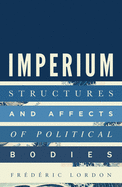
What should we do with the ideals of internationalism, the withering away of state and horizontality? Probably start by thinking seriously about them. That is to say, about their conditions of possibility (or impossibility), rather than sticking to the wishful thinking which asserts that for them to happen it is enough to want them. Humanity exists neither as a dust cloud of separate individuals nor as a unified world political community. It exists fragmented into distinct finite wholes, the forms of which have varied considerably throughout history?the nation-state being only one among many, and certainly not the last. What are the forces that produce this fragmentation, engender such groupings and prevent them from being perfectly horizontal, but also lead them to disappear, merge, or change form? It is questions such as these that this book explores, drawing on Spinoza?s political philosophy and especially his two central concepts of multitudo and imperium.
IMPERIUM: STRUCTURES AND AFFECTS OF POLITICAL BODIES
AUTOR/A
LORDON, FRÉDÉRIC
Ingeniero y doctor en Economía, trabaja como director de investigación de segundo nivel del CNRS (Centre National de la Recherche Scientifique) en el Bureau d?Économie Théorique et Appliquée (BETA) del Polo Europeo de Gestión y de Economía de la Universidad Louis Pasteur de Estrasburgo. Ha dirigido y participado en diversas obras colectivas y es autor de numerosos artículos en revistas como Cahiers d?Économie Politique, Économie Appliquée, Journal Evolutionary Economics, Oxford Review of Economic Policy, Revue Économie Politique y Revue Économique. Ha publicado varios libros, entre los que destacan los que analizan, desde una perspectiva crítica, la evolución reciente de las finanzas internacionales. Entre los títulos más relevantes pueden citarse: Fonds de pension, piège à cons? (Éditions Raisons d?Agir, 2000), La politique du capital (Éditions Odile Jacob, 2001) y Et la vertu sauvera le monde? De la débâcle financière au salut par ?l?éthique?? (Éditions Raisons d?Agir, 2003).